The First Sixty Seconds
Shut off the water. Everything else is secondary and stays secondary until the water stops.
A failed half-inch supply line runs roughly 500 gallons an hour — about a full bathtub every seven minutes, pouring into walls, floors, and ceilings until someone closes a valve. The difference between a two-room loss and a whole-floor loss is usually measured in how long it took to find the shutoff.
If you do not know where yours is, find out now rather than at 2am.
Where the Shutoff Is
In most Central Texas homes, you have two options:
The main shutoff at the house. Typically where the supply line enters — often on the garage-side exterior wall, sometimes in a utility closet. A lever-style ball valve turns a quarter turn; an older round gate valve may need several full turns clockwise and can be stiff enough to need both hands.
The meter box at the curb. A rectangular plastic or concrete lid near the street. Inside is a valve that usually requires a meter key, though a crescent wrench often works. This is the backup when the house valve fails or cannot be reached.
Fixture stops. If the failure is clearly at one toilet, sink, or water heater, the small oval or lever valve on the wall behind it isolates that fixture without killing water to the whole house.
Water heaters have their own shutoff on the cold inlet at the top of the tank. A tank that has let go will keep emptying and then keep refilling until that valve is closed.
Then Electricity — Carefully
If water is anywhere near outlets, the panel, or a floor you would have to stand in to reach the breakers, do not touch the panel. Cut power at an exterior disconnect if you have one, or call the utility.
This is the one step where the right move is to wait for someone qualified. Everything else in this list you can do yourself.
Document Before You Clean
The instinct is to start hauling wet things outside. Resist it for ten minutes, because this is where an insurance claim is won or lost.
- Wide video of every affected room before anything moves
- Close photos of the failed pipe, hose, or fitting — keep the failed part itself
- Standing water depth photographed against a baseboard or door frame for scale
- Photos of contents and furniture in place, before relocation
Then call your carrier, even if you do not yet know the scope. Policies require prompt notice, and a same-day call removes an argument the adjuster might otherwise make.
What Not to Do
- Do not wait for the adjuster to start drying. Your policy obligates you to mitigate. Damage that spread because you waited is damage the carrier can decline.
- Do not throw damaged materials away. Photograph, set aside, and let the adjuster see them.
- Do not run the HVAC if water reached ducts or if mold is already visible — you will distribute spores through the house.
- Do not use a household vacuum on standing water.
- Do not assume drywall is fine because it looks fine. Water wicks upward well past the visible line.
Why the Next 24 Hours Decide the Cost
Mold can begin growing within 24 to 48 hours in Central Texas conditions. That window is the whole economics of a water loss.
Extract and dry inside it, and a burst pipe is a repaired inconvenience — extraction, three to five days of air movers and dehumidification, some drywall. Miss it, and the same event becomes a mold remediation project with containment, licensed assessment, and demolition, often under a much smaller insurance sublimit than the water damage itself.
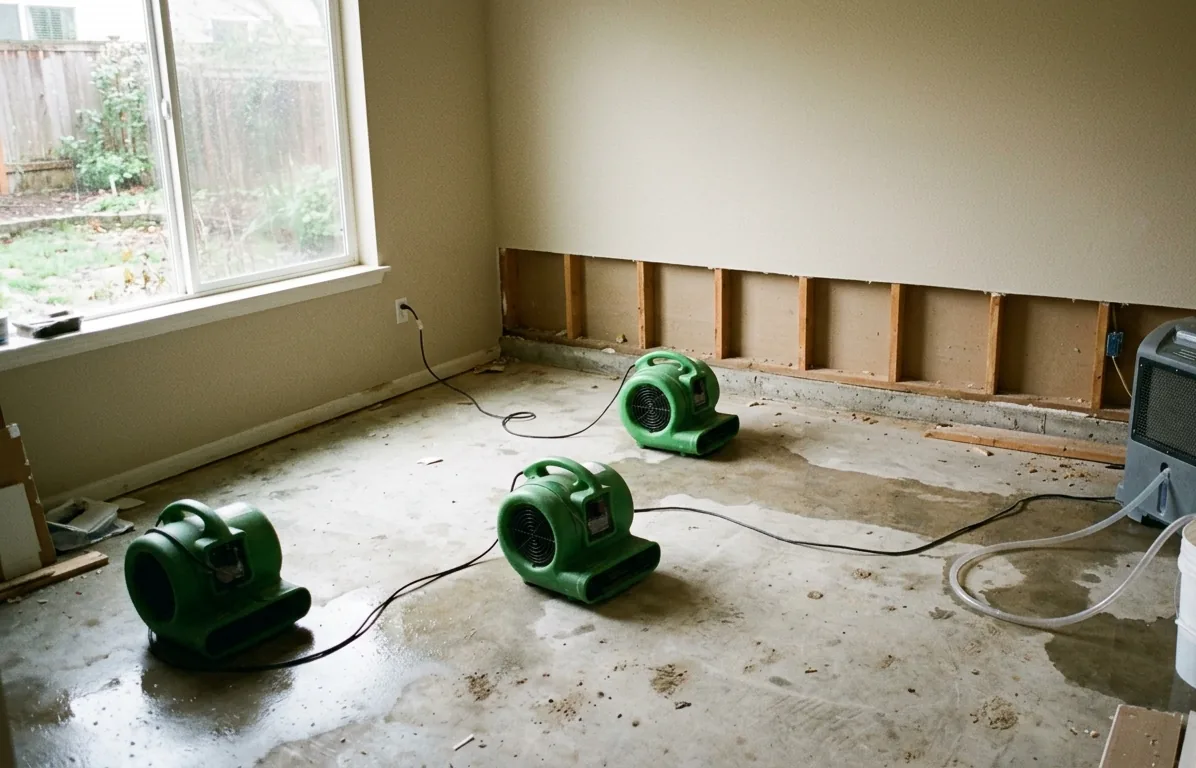
Structural drying is not fans. It is air movers placed to break the boundary layer at wet surfaces, dehumidification sized to the space to pull released moisture out of the air, and daily moisture readings that decide when equipment comes out. Material that feels dry to the hand regularly reads wet inside.
Why Pipes Burst Here
Two distinct causes, and neither is what people expect from Central Texas.
Infrequent hard freezes. Because deep freezes are rare, homes here are not built for them — exposed lines in garages, attics, and exterior walls often have no insulation. When the temperature does plunge, those split. The damage usually appears on the thaw, hours after the cold passes, which is why the calls come in waves.
Shifting clay soil, year round. Pflugerville sits on blackland prairie clay that swells when wet and shrinks hard in drought. That constant movement fatigues rigid copper and CPVC around and under the slab, cracking lines with no freeze involved. A slab leak is often a slow burst nobody notices until the water bill doubles or a warm spot shows up on the floor.
Want someone to look at your specific situation?
Send the short version and a local restoration pro will come back to you with a straight answer — no obligation, no call-centre runaround.
Emergency instead? Call (737) 210-8610 — answered 24/7.
Frequently Asked Questions
+ How much water does a burst pipe release?
A failed half-inch supply line runs on the order of 500 gallons an hour — roughly a full bathtub every seven minutes. That volume does not sit politely on the floor; it wicks up drywall, saturates carpet pad, and travels under flooring and along joists into rooms that look completely dry.
+ Should I turn off the electricity if a pipe bursts?
If water is near outlets, near the panel, or on a floor you would have to stand in to reach the breaker box, do not touch the panel. Cut power at the exterior disconnect if you have one, or call the utility. Standing water and electrical panels are the one part of this where waiting for a professional is the correct answer.
+ Can I just dry it out myself with fans?
Box fans move room air; they do not remove water from inside building materials. Structural drying uses air movers positioned to break the boundary layer plus dehumidification to pull moisture out of the air as it releases, monitored with meters. Surfaces that feel dry to the hand routinely still read wet inside, and that is where mold starts within 24 to 48 hours.
More Guides
Need help in Pflugerville right now?
Talk to a live person, not a call center. Free estimates for Pflugerville and surrounding areas.
Call (737) 210-8610